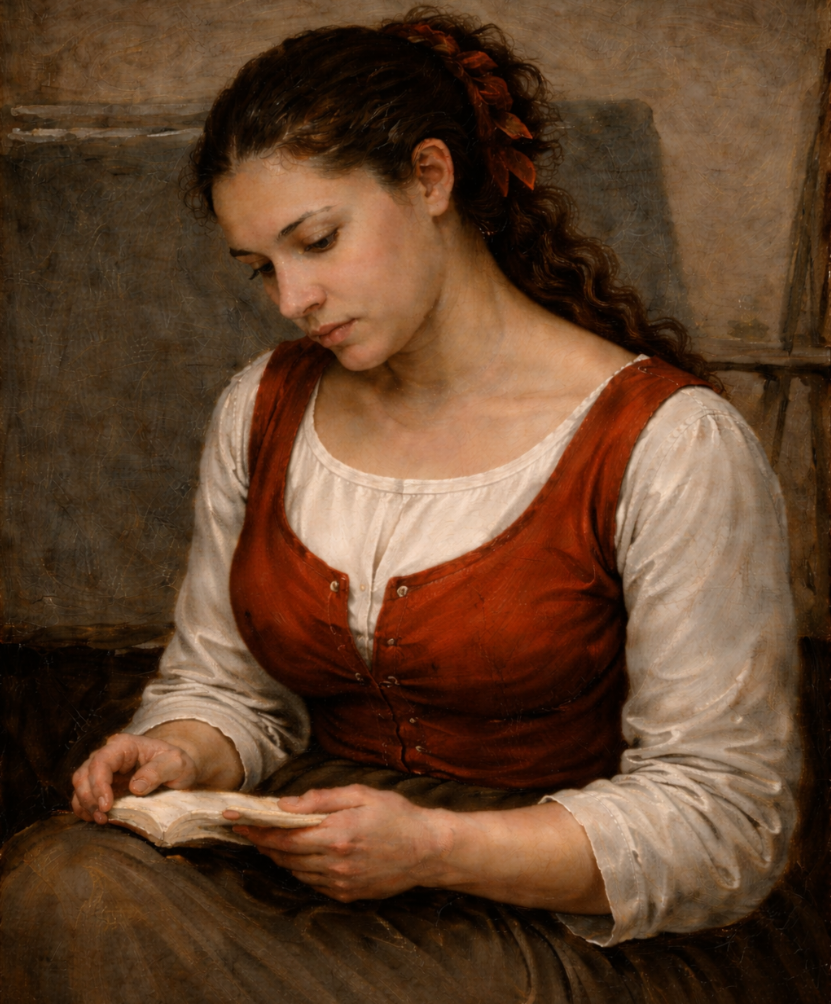
Cyber Faerie — Prologue


The path ran between stones. On one side the remnants of a settlement. Some of the walls were still standing to the height of a man, others returned to rubble. A minaret was still intact at the far end of what might have once been a souq, everything else was at various stages of going back to the ground. On the other side was an open slope with earth that had given up expecting rain. But the road was clear enough, despite not being maintained.
Rami had been watching the settlement since they came around the bend. Not from curiosity. Everything looked the same out in the Syrian interior. Late summer had this quality that wore down time. The sun had been working on the stone all day and the stone was giving the heat back now, pushing it upward from the ground so that the air between your feet and your face became a second surface, a warm pressure that followed you from site to site.
He had lost count of the sites — somewhere past seven, he thought, though the afternoon heat had made the counting unreliable. This one was different from the others. He was clear about that. But the precise difference escaped him.
Zayd came alongside him, the secondary line coiled over one shoulder, and handed Rami the driver without breaking stride. It was the kind of exchange the day had made automatic. The monitor on Rami’s chest gave a faint tone and went quiet. Within range. Same as it had been all day.
Zayd was about the same age as him and also from Aleppo, the one who usually laughed most easily and had laughed least today. He had been working in focused silence since the fifth site.
“Almost done,” Zayd said.
Rami nodded. His mind was too focused on pinpointing what was unique about this settlement to vocalize a response.
“You’ve been somewhere else since the last one.”
Rami looked at the settlement a moment longer. A courtyard wall on the slope above them still had a fig tree growing through it that had no business still being alive. He watched it for a moment, pondering the stubbornness of it, the way it had found whatever it needed in this place that had stopped offering anything.
“My grandmother used to go to one of these,” he said finally. “Not a grave — to a teacher. But the same problem.”
“What kind of teacher?”
“The kind you go to when you want to be near someone you believe is wise.” He paused. “She didn’t ask questions about him. She just went and sat and listened and came home. Did this for fourteen years.”
Zayd waited. “And?”
“And she came back different each time. Not dramatically. Just — a little more settled each time. Like something in her was being slowly resolved that the rest of us couldn’t see. She used to sit differently afterward. The way she held herself. My mother noticed it before the rest of us.”
“Did your mother say anything?”
“She used to watch her silently from across the room. Like she was trying to work out what had changed and whether it was the kind you could trust.”
They walked. The settlement continued on their left — the collapsed arch, the base of the larger structure, the wall with the fig tree. The road curved slightly and the settlement fell behind them.
“Was he?” Zayd said, after a while.
“Was he what?”
“Wise.”
Rami held the question. The answer that came immediately was the one he had been given — the criterion, its transmission, this new world they had all been formed by. Was he wise? Am I wise? Between knowing the answer and saying it there was her face. The face of someone at peace. From where he stood none could verify it. So be thou not among the doubters. And be not thou among those who deny the signs of God, lest thou shouldst be among the losers. He recited the answer.
“I don’t know. We couldn’t confirm his tradition. Whether that means anything about what she received—” He left the sentence where it was.
Durant had been walking close enough behind them to have heard most of this. He did not speak immediately. He matched their pace for a few steps, as if deciding how to engage.
“The experience was real,” he said. “Whatever she received there. That part I believe.”
“Then what’s the problem,” Zayd said, turning.
“The problem is that a real experience can point at the wrong thing.” Durant looked ahead down the path rather than at either of them. “Or at the right thing through the wrong door. What it opens in you afterward — that’s what matters. Not how it felt at the time.”
Rami turned this over. It felt right but he knew it had the shape of a resolution without quite being one.
“She didn’t live long enough for us to know,” he said.
Nobody answered this.
The path ran on. The slope to their right flattened and the view opened up — the desert extending in every direction with the flatness of permanence and abandonment. The late afternoon light pressed everything into its own shadow. Somewhere behind them the vehicle was parked where the road gave out, and ahead of them the mausoleum was not yet visible but was present in the sense that they knew it was there.
Rami looked at the open ground. He thought about the years of his grandmother going and coming back, and the family watching the changes accumulate without understanding it, and then finding out, and what it would feel like to be the person who had to tell her that the trust was misplaced. He had not been that person. She had died before any of them found out.
Hanni came alongside on the sloped side, having caught up. He had been reading something on the walk and pocketed it now. “The hunger for wisdom is right,” he said, as though entering a conversation he had been thinking about for longer than they had been having it. “A real teacher finds hunger and feeds it. A false one finds the same hunger and feeds it too. The hunger can’t tell the difference. That’s the real problem.”
“She wasn’t stupid,” Rami said.
“No,” Hanni said, without hesitation. “I didn’t mean to say she was.”
Rami felt the distinction, was grateful for it, and they walked on.
“The problem isn’t the people,” Hanni said, after a while. More to himself than to anyone specific. “The problem isn’t even the hunger. The problem is that there’s no one left.”
“The desert wants to be clean,” Durant said, quietly. “That’s all any of this is. Everything she was looking for, everything any of them were looking for — it’s real. The hunger is real. We’re just trying to make sure there’s somewhere honest for it to go.”
Hanni was quiet for a moment. Then he nodded once, and said nothing more.
The mausoleum was visible ahead. Lux, their leader, had already stopped in front of it.
Zayd looked at the site, then back at the track they had come down, then at Rami. “Lost count somewhere around seven,” he said. “Could be eight. Could be six.” He gave a brief laugh. It was the reflex of a man who had been carrying the day and found one moment of absurdity in it. The laugh carried alone across the sand.
The others drifted forward. The conversation did not end so much as settle back into the ground. Rami walked and said nothing. The fig tree was still back there somewhere on the slope.
The mausoleum was different from the others. Rami felt it more clearly now, up close, though he still could not have said precisely what made it different. Older, maybe. More settled into the ground. The walls had the look of something that had long since decided not to collapse.
Hanni crouched near the cornerstone and looked at the inscription on its face. “I can’t read this,” he said. He ran a thumb along the edge of the carving. “Old. Very old.”
“None of us can,” Durant said. He was looking at the upper edges of the walls, where the stone had begun to separate along lines that had been working themselves open for a long time. “It’ll come apart easier than the others. The mortar’s been gone for decades.”
Lux, who had been surveying the perimeter of the tomb, stopped. He looked at the inscription without crouching, from standing height, and his expression was the same cool certainty as always. “Someone could read it,” he said. “Someday soon someone will come here and be able to read it. And then they’ll ask what it means. And then they’ll want to know whose it is.”
Durant looked at the stone for a moment, then at Rami. “We’re answering that for them. Before they can.”
Hanni stood and nodded.
Lux turned to look at the group, taking them in one by one as he spoke. “The desert wants to come back to God. All of it. Every piece.” He looked at the cornerstone, then at the ground around it. “We’re almost done.”
The silence that followed was not the silence of men persuaded. It was the silence of men returned to themselves.
Rami checked his monitor and set his hands to the driver. The stone was warm from the day. Warmer than his hands.
They worked together on Lux’s count and the cornerstone moved — grinding, reluctant, then sudden. He was still at the driver when the wall behind him spoke, a low sound like a word in a language made of weight, and then the dome came down.
He heard Zayd call his name — one syllable, the sound of a warning arriving a breath too late — and then the pain came, brief and total, and then it was gone.
The light changed. Not the quality. The source. The afternoon sun was still there, its warmth and direction, but it had become background. In its place there was a figure.
The first thing he felt was that he was not afraid. This arrived before everything else — before understanding, before any account of what stood before him — and it was not the absence of fear in the way that numbness is an absence. It was its own presence. A warmth that was not the afternoon. A sense of being known by something that had always known him, meeting him now for the first time face to face.
Rami understood, then, what this was.
And he understood that being given this — being allowed to know, being prepared for what was coming — was mercy. Not the mercy you ask for. The mercy that had been arranged before you knew you needed it.
Man rabbuk?
He had answered this question a thousand times in the register of a man of faith. But that was no longer available. What was available was the question itself, and what he held in response to it, and what he found when he looked at it directly was not what he had feared.
He answered.
Ma dinuk?
He thought of the morning. The first stone, the recitation under his breath, the intention he had brought to the work and the imperfection alongside it, both of them visible. He thought of his grandmother’s face — not a distant memory now but simply real, as it had always been real.
He answered.
The third question was forming. He could feel its approach. And it was in this moment — the question still arriving — that he became aware of her.
She had been there for some time, he thought, but he noticed her now the way you notice something that doesn’t quite belong to where it is — not wrongly, not as an intrusion, but as a thing with its own origin. The figure was simply here, the way the questioning was simply here. But she had come. She was turned toward the questioning the way someone turns toward a voice they almost recognize, leaning in, listening for something specific in what was being asked and answered. That was the difference. Movement that had a destination. She was looking at the questioning with an intensity in her face he didn’t have a name for.
He looked at her and found himself with a question of his own. The mercy was still present, unchanged. The question she produced in him was not about his answer. It was about her.
The third question arrived.
Rami answered it with the name he had said ten thousand times, the name that gathered everything, and in the moment of answering he looked at her directly.
What was in her face was an expression he could not place. Not recognition. Something before recognition.
He did not understand it.
He was no longer in a position to examine what he did not understand, and the question of her went the same way — not answered, not finished. Just carried.
Looking for comments…
Searching Nostr relays. This may take a moment the first time this article is opened.
Looking for comments…
Searching Nostr relays. This may take a moment the first time this article is opened.