
Du hast noch nie etwas getan...

- Handeln ohne Handelnden — Wei Wu Wei
- Das Autofahren
- Das Libet-Experiment
- Der Koffer im Zug
- Die Suche nach dem Täter
- Wei Wu Wei — Handeln ohne Handelnden
- You have never done anything.
English Version below
Handeln ohne Handelnden — Wei Wu Wei
Nicht ein einziges Mal in deinem Leben. Jede Entscheidung, die du je getroffen hast, war bereits getroffen — bevor du es wusstest.
Das klingt absurd. Vielleicht sogar beleidigend. Du willst widersprechen — und genau dieses Widersprechen ist auch schon passiert, bevor du dich dazu entschieden hast.
Bleib kurz dabei. Nicht als spirituelle Übung. Nicht als östliche Philosophie. Sondern als schlichte Frage: Wer bist du eigentlich, wenn du handelst?
Das Autofahren
Jeder kennt diesen Moment. Man fährt eine längere Strecke, kommt an — und denkt: Warte mal. Die letzten vierzig Minuten. Wer hat da eigentlich gelenkt? Gebremst? Auf die Spur geachtet?
Es lief alles. Fließend. Sicher. Vielleicht sogar besser als sonst, als man “aufgepasst” hat.
Und dann meldet sich das Ich. Sofort. Nachträglich. Ich war das. Ich habe das gemacht. Ich habe nur nicht drüber nachgedacht.
Das Ich taucht immer auf, nachdem alles vorbei ist — und beansprucht die Urheberschaft.
Wie ein König, der nach der Schlacht erscheint und sagt: mein Sieg.
Das Libet-Experiment
Neurowissenschaft — Benjamin Libet, 1983
Probanden werden an EEG-Elektroden angeschlossen. Sie sollen spontan eine Handbewegung ausführen und dabei notieren, wann sie den Impuls gespürt haben. Das Ergebnis: Die Hirnaktivität — das sogenannte Bereitschaftspotential — setzt mehrere hundert Millisekunden vor dem bewussten Entschluss ein. Die Entscheidung ist bereits gefallen, bevor das Ich sie bemerkt. Auf die Frage “Warum haben Sie die Hand gehoben?” antworten alle: “Weil ich es wollte.” Nachträglich. Immer nachträglich.
Das Ich ist kein Fahrer. Das Ich ist ein Kommentator. Wie beim Sport — die Stimme im Radio beschreibt was passiert, aber sie schießt kein Tor.
Wir haben unser ganzes Leben geglaubt, wir wären beides: Kommentator und Spieler. Aber vielleicht war das Ich immer nur die Stimme, die erklärt, was schon passiert ist.
Der Koffer im Zug
Stell dir vor, du fährst Zug. Du hast einen schweren Koffer dabei. Und du hältst ihn die ganze Fahrt in der Hand. Hochgehoben. Angespannt. Du sorgst dafür, dass er ankommt.
Der Zug fährt sowieso. Der Koffer kommt sowieso an.
Die einzige Frage ist: Willst du die gesamte Reise mit dem Gewicht in den Armen verbringen?
Das Kontrollieren selbst ist die Last. Nicht das Leben.
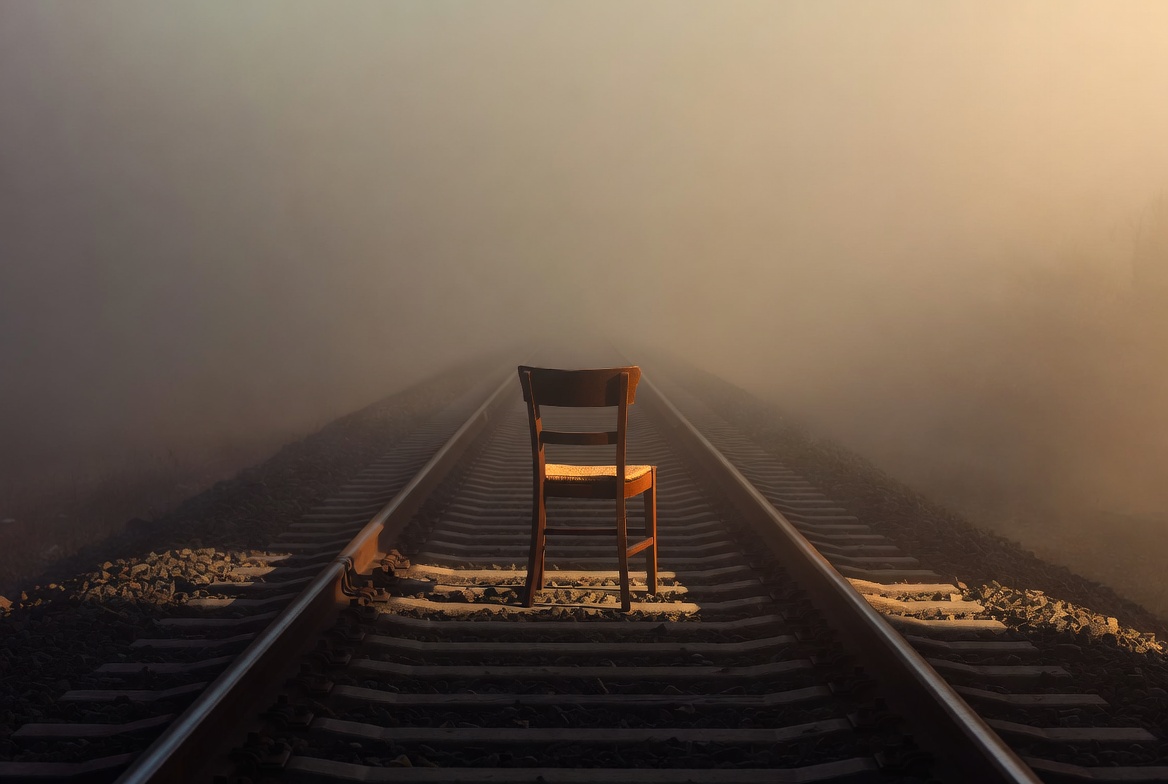
Und dann das Karussell-Auto. Jedes Kind kennt es — das kleine Lenkrad, das sich dreht ohne etwas zu lenken. Das Kind dreht trotzdem. Wild. Überzeugt. Links, rechts, geradeaus. Das Gefühl von Kontrolle ist so befriedigend, dass die Schienen darunter gar nicht auffallen.
Was wenn wir alle im Karussell-Auto sitzen? Das große Lenkrad in der Hand. In voller Überzeugung. Und das Leben fährt auf Schienen — hat immer auf Schienen gefahren.
Die Suche nach dem Täter
Ich mache das selbst. Wenn etwas passiert ist — eine Reaktion, eine Entscheidung, ein Wort das rausgerutscht ist — frage ich mich: Wer hat das getan? Warum habe ich so gehandelt?
Und wenn ich dieser Frage wirklich nachgehe, finde ich: niemanden. Ich finde Umstände. Konditionierungen. Ursachen die auf Ursachen folgen. Eine Kausalität die sich zurückverfolgen lässt — aber keinen Täter am Ende der Kette.
Und hier liegt vielleicht die ehrlichste Einsicht: Man kann diesen Zustand nicht erfahren. Nicht als Erlebnis, nicht als Erleuchtung. Denn in dem Moment, wo man es erfahren würde, bräuchte man ein Ich das erfährt. Und genau das ist nicht da.
Das Auge kann alles sehen — nur sich selbst nicht.
Was bleibt, ist keine dramatische Erleuchtung. Sondern eine stille Untersuchung. Und die Untersuchung kommt immer zum selben Ergebnis.
Wei Wu Wei — Handeln ohne Handelnden
Die Taoisten haben das vor 2500 Jahren so genannt: Wei Wu Wei. Wörtlich — Handeln ohne Handeln. Oder genauer: Handeln ohne Handelnden.
Das ist keine Technik. Keine Meditation, die man lernen kann. Kein Zustand, den man erreicht und dann wieder verlässt. Es ist die Beschreibung von dem, was schon immer so war.
Das Leben geschieht. Der Atem kommt und geht ohne Erlaubnis. Das Herz schlägt ohne Anweisung. Gedanken tauchen auf — niemand hat sie bestellt. Und irgendwo in diesem Strom hat sich eine Stimme etabliert, die sagt: Ich. Ich tue das. Ich bin das.
Wei Wu Wei fragt nicht, wie man diese Stimme zum Schweigen bringt. Es fragt nur: War sie je der Dirigent — oder hat sie immer nur mitgesungen?
Es gibt nichts zu tun. Es war immer schon so.
Und vielleicht ist das keine deprimierende Erkenntnis. Vielleicht ist es das Gegenteil. Wenn kein Handelnder da ist — wer trägt dann die Last? Wer muss sich schämen? Wer muss alles im Griff haben?
Der Koffer darf abgesetzt werden. Der Zug fährt sowieso.
You have never done anything.
Acting without an actor — Wei Wu Wei
(English version)
Not once in your entire life. Every decision you have ever made was already made — before you knew it.
That sounds absurd. Perhaps even offensive. You want to object — and that objection has already happened before you decided to make it.
Stay with this for a moment. Not as spiritual practice. Not as Eastern philosophy. Simply as a question: Who exactly are you when you act?
Driving
Everyone knows this moment. You drive a long stretch, arrive — and think: wait. The last forty minutes. Who was actually steering? Braking? Keeping to the lane?
Everything ran. Smoothly. Safely. Perhaps even better than usual, better than when you were “paying attention.”
And then the I appears. Immediately. Retrospectively. That was me. I did that. I just wasn’t thinking about it.
The I always appears after everything is over — and claims authorship.
Like a king who appears after the battle and says: my victory.
The Libet Experiment
Neuroscience — Benjamin Libet, 1983
Subjects are connected to EEG electrodes. They are asked to make a spontaneous hand movement and note when they felt the impulse. The result: brain activity — the so-called readiness potential — begins several hundred milliseconds before the conscious decision. The decision has already been made before the I notices it. When asked “Why did you raise your hand?” everyone answers: “Because I wanted to.” Retrospectively. Always retrospectively.
The I is not a driver. The I is a commentator. Like in sports — the voice on the radio describes what happens, but it doesn’t score the goal.
All our lives we believed we were both: commentator and player. But perhaps the I was always only the voice that explains what has already happened.
The Suitcase on the Train
Imagine you’re on a train. You have a heavy suitcase. And you hold it up the entire journey. Arms raised. Tense. Making sure it arrives.
The train moves anyway. The suitcase arrives anyway.
The only question is: do you want to spend the entire journey with that weight in your arms?
The controlling itself is the burden. Not life.
And then the carousel car. Every child knows it — the little steering wheel that turns without steering anything. The child turns it anyway. Wildly. Convinced. Left, right, straight ahead. The feeling of control is so satisfying that the rails underneath go unnoticed.
What if we are all sitting in the carousel car? The big steering wheel in our hands. In full conviction. And life runs on rails — has always run on rails.
Searching for the Doer
I do this myself. When something has happened — a reaction, a decision, a word that slipped out — I ask: who did that? Why did I act that way?
And when I truly follow that question, I find: no one. I find circumstances. Conditionings. Causes following causes. A chain of causality that can be traced back — but no doer at the end of it.
And here lies perhaps the most honest insight: you cannot experience this. Not as an event, not as enlightenment. Because in the moment you would experience it, you would need an I that experiences. And that is precisely what is not there.
The eye can see everything — except itself.
What remains is no dramatic enlightenment. Just a quiet investigation. And the investigation always arrives at the same result.
Wei Wu Wei — Acting Without an Actor
The Taoists named this 2500 years ago: Wei Wu Wei. Literally — acting without acting. Or more precisely: acting without an actor.
This is not a technique. Not a meditation you can learn. Not a state you reach and then leave again. It is a description of what has always been the case.
Life happens. The breath comes and goes without permission. The heart beats without instruction. Thoughts arise — no one ordered them. And somewhere in this stream, a voice established itself saying: I. I do this. I am this.
Wei Wu Wei does not ask how to silence this voice. It only asks: was it ever the conductor — or has it always just been singing along?
There is nothing to do. It has always been this way.
And perhaps this is not a depressing insight. Perhaps it is the opposite. If there is no actor — who carries the burden? Who must feel ashamed? Who must have everything under control?
The suitcase may be set down. The train moves anyway.
#WeiWuWei #FreeWill #Consciousness #NoSelf #Philosophie #Taoism #LongForm
Loading comments…