
Too General to Do Anything Useful With


Too General to Do Anything Useful With
You’ve been warned!
ⓘ NOTE: This essay originates from a recent discussion in an educational setting. The phrasings may have been workshopped with AI to land more accurately with my intentions, but the ideas and composition are my own—em dashes and all.
The Anthro-Uniqueness
What makes humans unique? This thing we have that separates humans from other animals. Life from non-life. Planets from asteroids.
I’m going to make the claim that we aren’t. Not because we aren’t special, but because I think the framing opens up a universe that is more alive than it would be starting off with the assumption that we’re the pinnacle of sophistication in the universe. Better than the view that we’re special in some dead, mechanistic universe.
Some Background
The methodology I’ll be using will be based in a sort of intuitive philosophy, but the lineage—and if you’ve read my more formal notes, you’ll know I talk about it often—derives great influence from French philosophers Gilles Deleuze and Felix Guattari’s A Thousand Plateaus, their second book in their work Capitalism and Schizophrenia. In this spirit, I’m not going to reproduce their work in an essay. Rather, I’m attempting to work with their work in this essay, rather than have this essay be about their work.
Perturbations of Meaning
Let’s start off with a thought experiment:
Freeze the world. Freeze your senses.
You can physically move, but nothing in the world moves and you are unable to detect any change in the world. What happens?
You’ve basically become a particle moving in space along some vector (from stage right enters the spherical cow). It will continue on for infinity, as nothing changes. That’s the unchanging universe.
Now, we introduce something different intersecting this particle’s path. It might be a wall, it might be another particle to collide with. What happens? Our original particle now must change its direction, mechanistically. It doesn’t do something completely different that didn’t exist already. It still moves, just at a different angle.

Now, back to you.
These words, if you are reading them, affect you in some way. Whether they bore you, annoy you with perceived nonsense to the point of closing this essay and moving on with your life, or perhaps they change how you view the world in some way in the future.
You are affected somehow, because you are no longer the same as you were a minute ago, having interacted with these words.
The Whorl
Back to particles.
Suppose we continue to add in more perturbations, enough to where the particle will be pushed into its original starting orientation. If there is a third, “static” particle in that place, it will be affected by the new displacement of the first, and its angle will too change.
But, by being a different particle, it’s not just recreating what came before it; it does something different because it exists in a world with a second particle, and that fundamentally changes things were there only one particle moving in a circular motion. From repetition-but-also-difference, we don’t get a circle. We get a spiral. A very old symbol.

Things are similar, but different. The musical refrain of keeping the same theme yet still evolving.
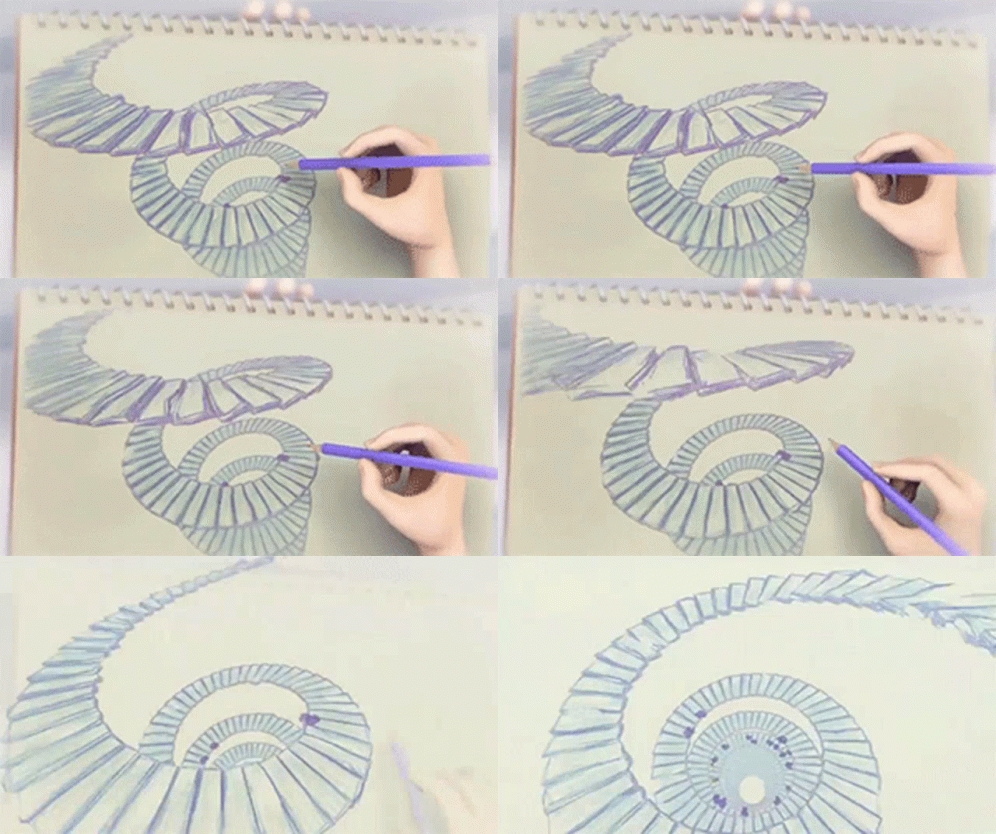
Because this spiral is continually changing over time, rhyming over each iteration, we can make this a 3D spiral, where the vertical axis is time as time goes on. Not necessarily better, but different. Different while containing an echo from the past.

Atoms coalesce into molecules, molecules into organisms, organisms into their phylogeny, into the various cladograms we see when studying evolution and common ancestors.
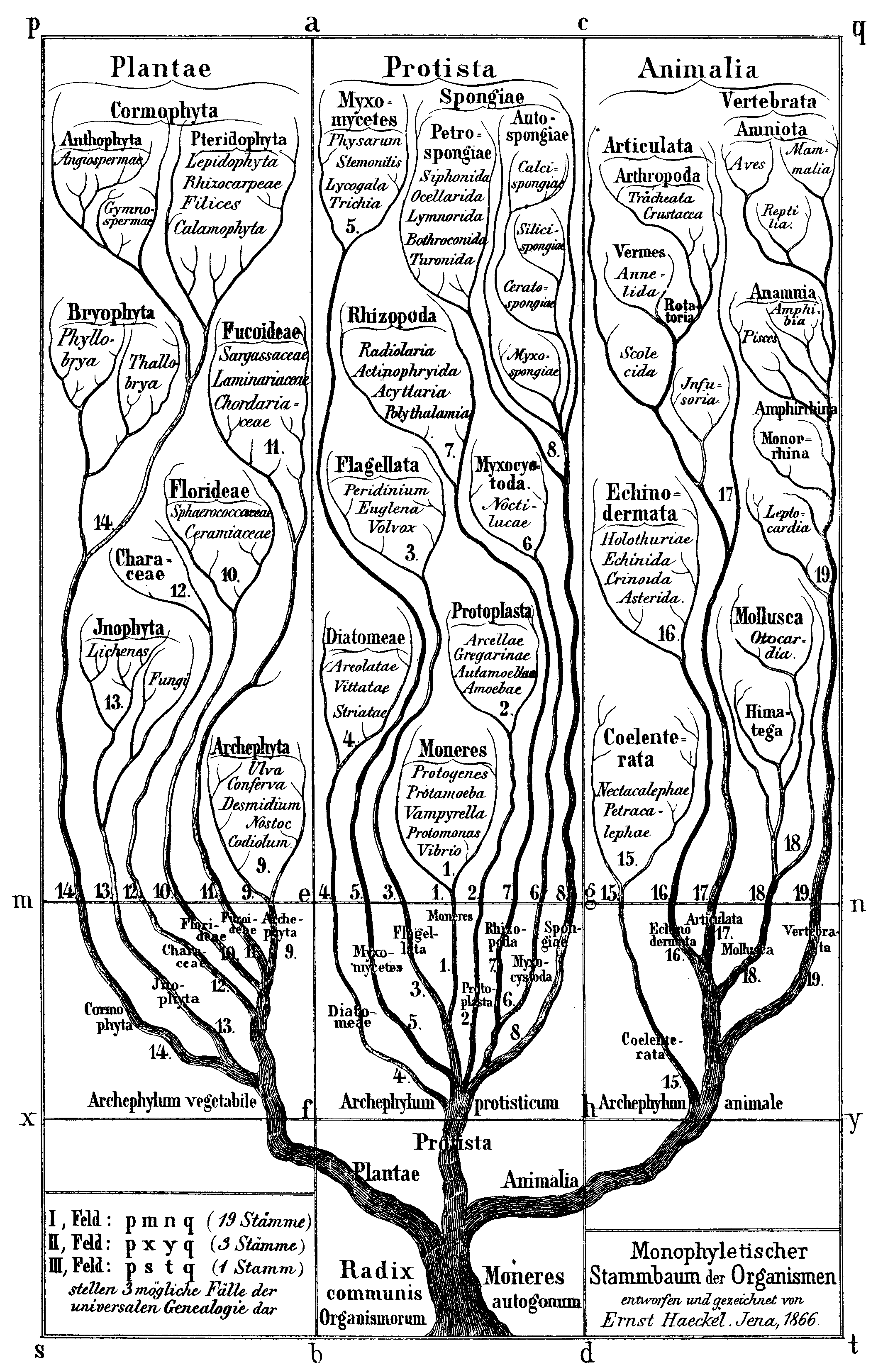
Each iteration is new, but they don’t come from nowhere. The specific capacity has always existed, but they exist through prior existing capacities.
The Rhizome
And now entering our show comes Deleuze and Guattari’s Rhizome, with its recurring obligatory explanation. The concept of the Rhizome derives its name from the original botanical term for underground stems that grow laterally and seemingly sprawl in all directions, growing and finding connections wherever they can. You can see the growth process clearly through time-lapse photography of potatoes growing.
https://v.nostr.build/yhYBDuDyQp2stplS.mp4
Mycelial growth as well.
https://v.nostr.build/xEoak.mp4
This is to contrast with what we think of as tree-like or arborescent processes, where there’s a root or source and everything branches out from it. If you look carefully at the potato time-lapse, you’ll see tree-like figures sprouting out, and that’s the point. A tree is a snapshotted instance of the larger rhizome; a rhizome is a processual, acentric structure without a uniform source. The tree is a single instance within the living forest rhizome.
But this is not just about trees, it’s about reorienting.

This perspective changes what we may see as tree-branching within a lung’s capillary system, or our body’s central nervous system with our spine and brain as our trunk to which everything else is derivative.

River deltas look like trees until you recognize that the self-similar branch is not derivative of the source river; rather, it is an active creation from similar recurrent processes that build an image of a tree. These branching things are not trying to be self-similar. Rather, future structure depends previous states. What manifests is influenced by the surrounding context.
And Yet…
We’re still going work with trees.
Suppose you’re a seed floating around, waiting for a place to land and sprout. Why are you here? I cannot say. You’re here and you need to sprout. You land on some land—harsh, cozy, it doesn’t matter. You still need to sprout somehow with whatever means you can.
So you sprout.
You enact on the potentials you’ve been given, whether it’s your specific species of tree and all the history embedded in it, or the nutrients of the environment it all contributes to the specific shape you will take. All this potential and growth, and you finally earn some stability through enduring your environment and learning to make it your home.
That stability, however, becomes the trunk, the bark that supports further growth. That tree will continue to grow, continue to build its trunk and calcify into the stability it’s earned. So let’s change perspective a little.
Now you’re a piece of that trunk, somewhere between the ground and the top leaves. You also want to grow, but the tree’s apex is blocking out your much-desired and needed nutrition, and the trunk’s calcification prevents you from immediately moving somewhere else. What do you do then?
You branch.
You branch away. Sprouting from trunk itself as ground, and find your way to earn your needs, calcifying in your own way to earn your own stability.
But the branch that strays too far from its trunk loses support.
At some point, a branch enduring a rough storm may fall off, having lost the capacity to be supported. But if you’re lucky, and I mean very lucky, you may find a nearby but different tree to support your weight and help your flourishing. You don’t need to entirely depend on the original trunk, but you still need support; you still need to be connected to grow and flourish.

Different, but connected all the same.
Your best bet for support is the lineage from which you came, but if you must stray, you still need support ideally support from both original and new.
The return, but different
Now, the spotlight closes on you, the particle in space. But you’re not in a frozen world with countable other particles. Why this position, with this orientation? I cannot say, but here you are. You are pushed in countlessly many ways through prior occurrences. You may think you are pulling your desires toward you, but a pull is just an inverted push.
Countless.
The key word. You cannot count the effects that are pushing against you. You cannot change what has pushed you, and you cannot change the things that you push thereafter.
However…
There is a thing. Seemingly infinitely small, so small one may forget it exists. That space in between, where perception and action hinges. The fulcrum that allows you attend to what perturbs you. If there is anything that you can control, that is it. How do you know what to attend to, what to be affected by, and what would you like to affect?
That which pushes you to line new lineages
connections to connect

Attend to your affects so that you may affect again
Looking for comments…
Searching Nostr relays. This may take a moment the first time this article is opened.
Looking for comments…
Searching Nostr relays. This may take a moment the first time this article is opened.