Why We Launched a Book on Nostr - and some thoughts on identity and a tool for you to use

The characters in my new novel Tamers of Entropy are cypherpunks. Of course they’re on Nostr and not on other platforms. It started as a practicality - I didn’t want to deal with e-mail addresses and whatever verification they need, it’s just too much hassle. I’d rather generate random numbers.

But here’s the thing: Nostr isn’t mentioned in the book. Bitcoin gets a passing note. Zero-knowledge proofs, hard money, decentralization — all of it is background noise and it’s a good thing. Infrastructure that works, not ideology that distracts.
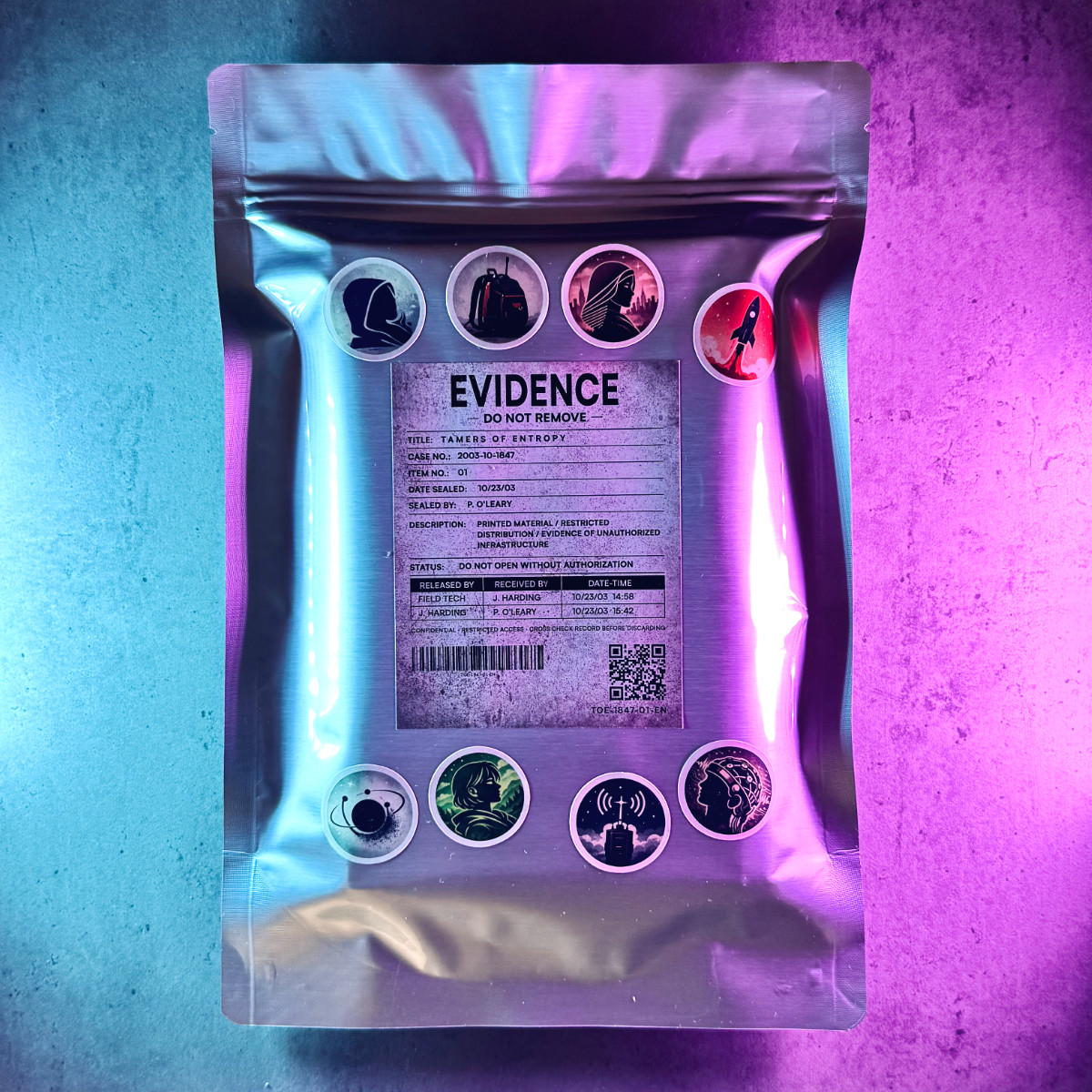
Image: Tamers of Entropy packaging, by No Good Kid . Note that this is a photo, not AI generated, this is the package of the book (the premium version with the audio, but paperback will be similar, just without the stickers).

Simplicity on the other side of complexity
There’s a concept I subscribe to - Simplicity on the other side of complexity. A hipster coffee stand at a Mexican beach is simplicity. There are two ways to get there - you just do it, or you first become a hedgefund manager, make lots of money and then the coffee stand is buying back your freedom.
These are two different coffee stands. Meaning - I am not discounting the complexity. We need to think about these things, use them, push them forward. But once we get it, we can remove the noise. Personally, I think simplicity at the other side of complexity is the holy grail of a good life. It’s not negligence, not even retardmaxxing - you figured out things so well that you’re simplifying, because you did the homework.
My friend bitpunk.fm is typing said it well: cypherpunks are too focused on cypher, and not enough on punk. The community got rich on Bitcoin and started confusing the tool with the mission. The mission was never about getting rich, although I don’t mind people who were right getting rewarded by serenity. Cypherpunk and cryptoanarchy was about building parallel paths — spaces where you don’t ask permission, where barriers are just information about where to build.
That’s what the book is about. Mesh networks. Infrastructure. Surveillance. People who see a wall and start digging. And about identity.
Nostr and Identity
So why Nostr for the launch?
It started with No Good Kid - the art director of the project. He once told me he’s Nostr-only. Dropped everything else. I thought: that’s insane. You’re an artist. You need reach. You need discovery. But he doesn’t need reach to a bunch of people. He uses it as a filter. He wanted a career change, work with different kind of people. So you go where those people are and you don’t need too many. He wanted to work with Bitcoiners, Nostr people, people who think differently. There’s not a crowd of them on Facebook.

Image (of and by): No Good Kid
Back to the identity, it rhymes with the themes in the book. He said that he wanted to stop using his name. Because for him, his name was attached to meetings, to corporations, to his CV and portfolio. No Good Kid is more fluid, it can be him, but also his collaborators sometimes.
Tamers of Entropy is looking at identity and there are two themes (without spoiling too much) that rhyme with this. You’ll notice that none of the characters, none of the authors and none of the collaborators use a surname. While I get why surnames are good for marketing sometimes (a friend is a lawyer and his surname marks a family tradition, it’s a brand), I subscribe to James Scott’s view that he presented in Seeing like a state. Surnames are herd control and taxation tools. The local overlords needed unique naming scheme to know who owes taxes. There has been a revolt in many parts of the world. People were giving their kids the same given name, making their whole names the same, in order to avoid head tax. “Yes, John has already paid the tax” - even though there were three Johns, with the same surname and parents. Actually in the novel, a few (quite important) characters don’t even have a name. Not even a nickname.
The second thing is that the use of names tricks us. Once we have a name, it assumes continuity. Juraj is the same guy you met 30 years ago in high school, I know him! No honey, you don’t know me, you know a Juraj from 30 years ago. We change, evolve all the time. I wouldn’t even want to have a tea with Juraj from 30 years ago - not that I don’t like him, but he was a kid, needing to figure things out and I have already figured them out. Our cells change, even our memories change. Experience changes us. This idea of continuous identity limits us too much. Yes, we are a continuity, but we’re a keypair away from being someone else, for a moment, for a project, for a purpose, for a fantasy, whatever. Changing our identities like clothes allows us to experiment.
That’s why I don’t like the “what do you do?” question. It implies what I do now is somehow tied to who I am. But what I do and who I am changes. “You don’t step into the same river twice”.
Nostr makes this easy. Every collaborator on this book — editors, designers, the whole team — has a Nostr identity in the credits. As the preferred way to reach them.
But it goes further. I made a few of the main characters their own Nostr keypairs. They’re posting now, before anyone has read the book. Commenting on what they see, jumping into conversations, existing in the world as themselves. Not AI-generated — written the way they would actually think and speak.
Right now their posts look like fragments from strangers. After you read the book, you’ll understand the lens they see through.
The book’s main page pulls their Nostr feed - Tamers of Entropy (which reposts all the posts by the characters - they each post under their own npub). Even if you’re not on Nostr yet, you can watch them post on the web.
For me it’s both fun and worldbuilding that doesn’t stop at the last page.
The Emanator
Managing twenty-ish Nostr identities taught me something: the protocol is simple, but the workflow is a design problem.
I have my main account. Project accounts — AnyPay.today and Cashu Pay Server for example. And now the characters. Each with their own keypair, their own voice.


The problem: no one follows an empty account. Even if the content is real, you’re shouting into a void. The solution is obvious — boost from my main account. But I don’t want to flood my feed with automated noise, and I don’t want to manually repost everything.
So I built Nostr Emanator. It queues character posts into the future so they post consistently. More importantly, it pre-signs reposts — when account A posts, account B automatically reposts. The Tamers of Entropy account collects all character posts. My main account boosts the projects. Content stays separate for people who want to follow just one thing, but gets reach through the network.
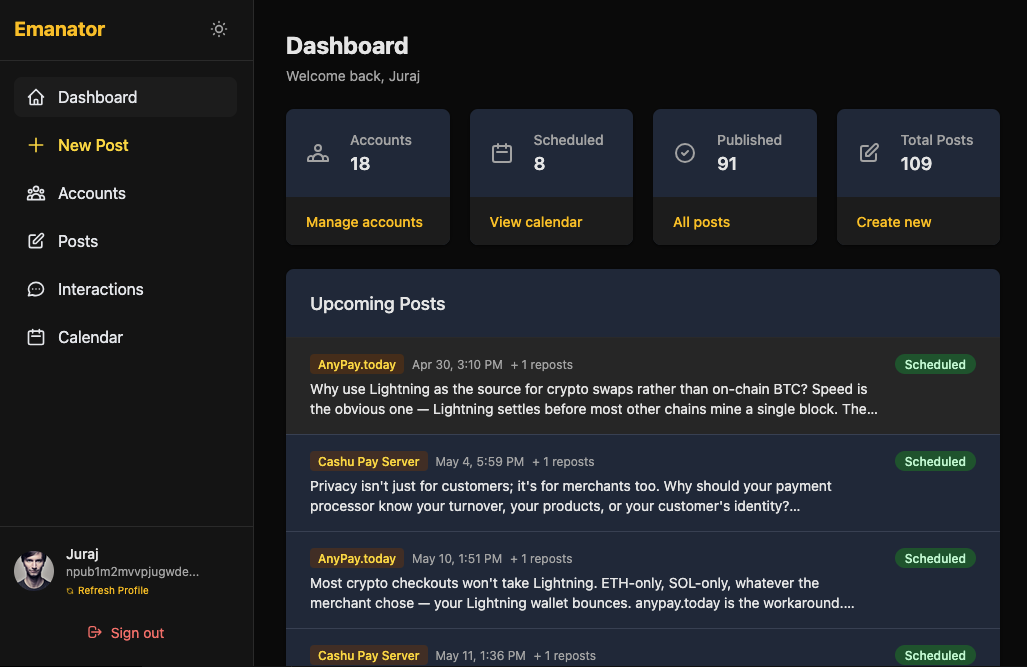
It also helps me to do multiple account interactions, mainly replies. People respond to posts. Existing Nostr clients make you switch accounts one by one. Emanator lets me monitor interactions across all identities from one interface, with the same mute list everywhere. If I mute someone on my main account, I don’t see their replies anywhere else either.
I think interactions are important. When someone finds time to react - engage with what you wrote, you should appreciate it, and maybe write something back.
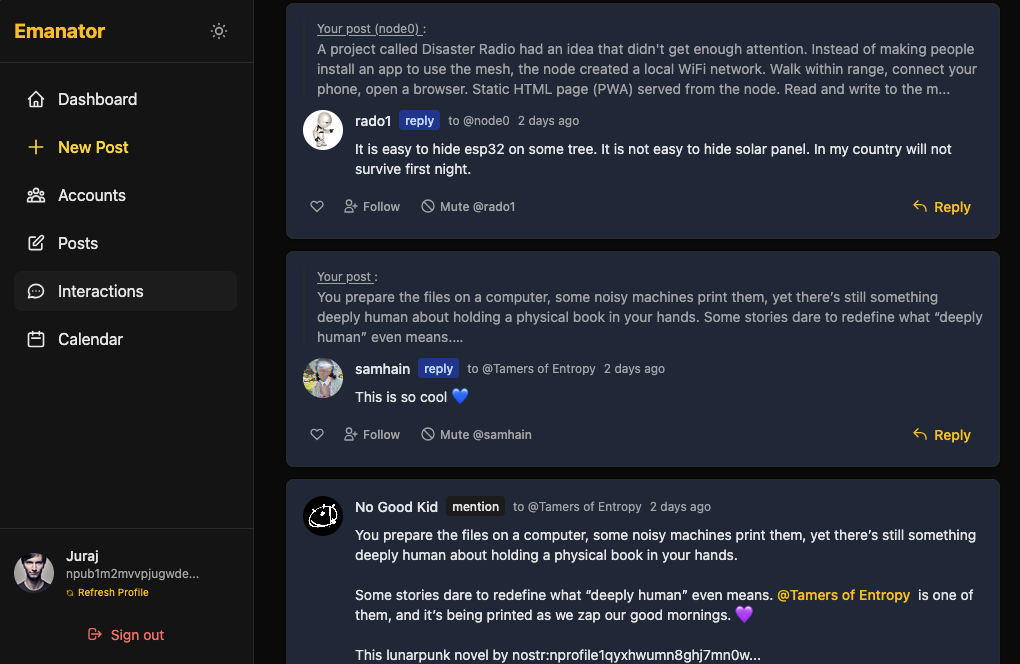
If you manage multiple Nostr identities, you probably need something like this. I built it because I needed it. The protocol carries the signal. Emanator just makes it manageable.
You can try it at emanator.cypherpunk.today. Right now, no monetization and it only supports remote signer (Amber), I don’t want any private keys.
Get the book! :)
It is amazing. Follow the characters, see what they are up to @Tamers of Entropy and get the book here: TamersOfEntropy.net. Available in English (original) and Czech and Slovak translations as paperback and audiobook.
Looking for comments…
Searching Nostr relays. This may take a moment the first time this article is opened.
Looking for comments…
Searching Nostr relays. This may take a moment the first time this article is opened.