
Free Article 1 (Nov. 28, 2025): The Bitcoin Chronicles: 1.A.1 - The Last Free Launch from Earth

Andrew G. Stanton - Nov. 28, 2025
I. No More Permission
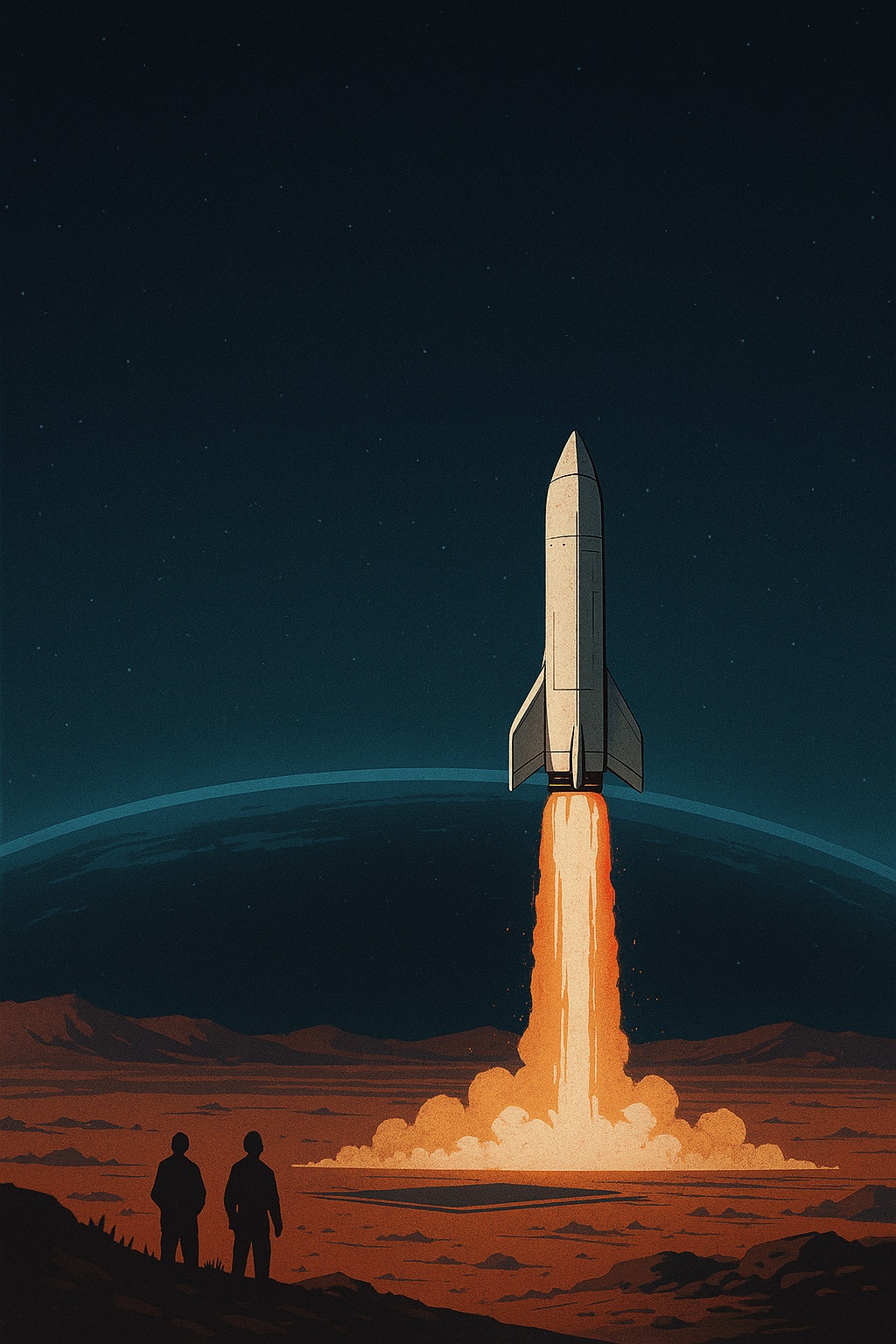
No one called it the last free launch when it happened.
Officially, Pilgrim-1 was a prototype vessel conducting “high-altitude testing.”
Unofficially, it was the final human ascent that did not pass through the growing maze of national authorizations, interagency registries, or the early Astral Enforcement Bureau.
Thirty-four crew members—engineers, linguists, orbital welders, cryptographers, medics—had spent years preparing for a future no longer dependent on Earth’s tightening compliance regime. They weren’t fleeing fire.
They were fleeing permission.
So they stopped waiting for approval.
And launched.
II. What They Left Behind
Earth wasn’t collapsing.
It was solidifying.
- identity systems tightening
- monetary systems inflating
- academic licensing narrowing
- AEB audit protocols expanding
- ecological volatility rising beneath a façade of order
The world still looked stable—cities glimmering, nations functioning—but the substrate beneath had hardened into a brittle, risk-averse architecture.
The Pilgrim-1 crew saw something clearly:
The future was no longer inside Earth’s systems.
It had to be found outside them.
III. The Countdown No One Saw
Atacama High Desert.
A private pad protected by legal ambiguity and old paperwork.
The countdown whispered through earpieces:
“Thirty seconds… ten… ignition.”
No crowds.
No anthem.
A few families watching from a distant ridge—knowing they might never see their loved ones again.
The ship rose into the thin desert air—no flag, no allegiance, only purpose.
IV. The Break Point
Sixteen minutes into ascent, Pilgrim-1 deviated from its registered test corridor.
The early AEB flagged it instantly.
Abort commands were transmitted through multiple channels.
Pilgrim-1 ignored them.
By the time intercept options were debated across overlapping Earth agencies, the craft had already committed to a translunar trajectory.
This wasn’t the last launch Earth would ever make—far from it.
Earth would continue launching for centuries: state missions, research vessels, licensed transports, corporate ferries.
But this was the last one that Earth did not control.
The last one not permissioned.
Not supervised.
Not governed.
The last ascent where human beings left Earth on their own terms.
V. The Moment of No Return
As the blue sphere fell behind them, navigator Dr. Amina Veirs made a quiet log entry:
“We are not abandoning Earth.
We are expanding it.”
History would later etch those words into monuments across sovereign space—from Luna Freeport to New Lakota to the Belt cooperatives who traced their origins to this moment.
Pilgrim-1 never returned.
And from that moment on, Earth’s sky shifted—from an open frontier to a tightly monitored border.
The stars were still reachable.
But no one would reach them freely from Earth again.
🜁 Archivist’s Note — Launch Classifications in the Early Sovereign Era
To understand why Pilgrim-1 is remembered as the Last Free Launch, it is important to distinguish the three categories of ascent recognized in the Sovereign Archive:
1. Free Launches (Pre-UEB)
- Unregulated, unpermissioned, untracked
- Conducted without state or AEB/UEB oversight
- Used home-built guidance systems, independent telemetry
- Ended permanently with Pilgrim-1
- Represent the final moment Earth’s sky functioned as an open frontier
2. Regulated Launches (UEB & State-Sanctioned)
- All launches from Earth after 1.A.1
- Require AEB/UEB authorization, trajectory signing keys, compliance firmware
- Include national space programs, corporate assets, research missions, and all state-bloc expeditions
- These launches continue for centuries
- Represent Earth’s shift from exploration to oversight
3. Illegal Launches (Earth & Off-World)
On Earth:
- Extremely rare
- Often intercepted, jammed, or prevented
- Attempted by defectors, underground sovereign groups, or fugitives
- High mortality rate
- A few succeed and become legendary in later arcs
Off-World:
- Common and culturally normal within sovereign habitats
- Conducted by independent colonies on Luna, Mars, Ceres, Callisto, Europa, Belt cooperatives, and the Outer Edges
- Free of UEB jurisdiction
- Build the backbone of interplanetary trade, culture, and innovation
- Form the foundation for the Entanglement Era
Why This Matters
Pilgrim-1 marks the end of free ascent from Earth.
Not the end of launch capability.
Not the end of exploration.
Simply the end of the sky as a place where human beings could act without permission.
This distinction shapes the next thousand years of the Chronicle canon.
Looking for comments…
Searching Nostr relays. This may take a moment the first time this article is opened.
Looking for comments…
Searching Nostr relays. This may take a moment the first time this article is opened.