
Free Article 1 (Dec. 4, 2025): The Bitcoin Chronicles - 1.B.3 - Luna Freeport

Andrew G. Stanton — December 4, 2025
I. A Place Between Worlds
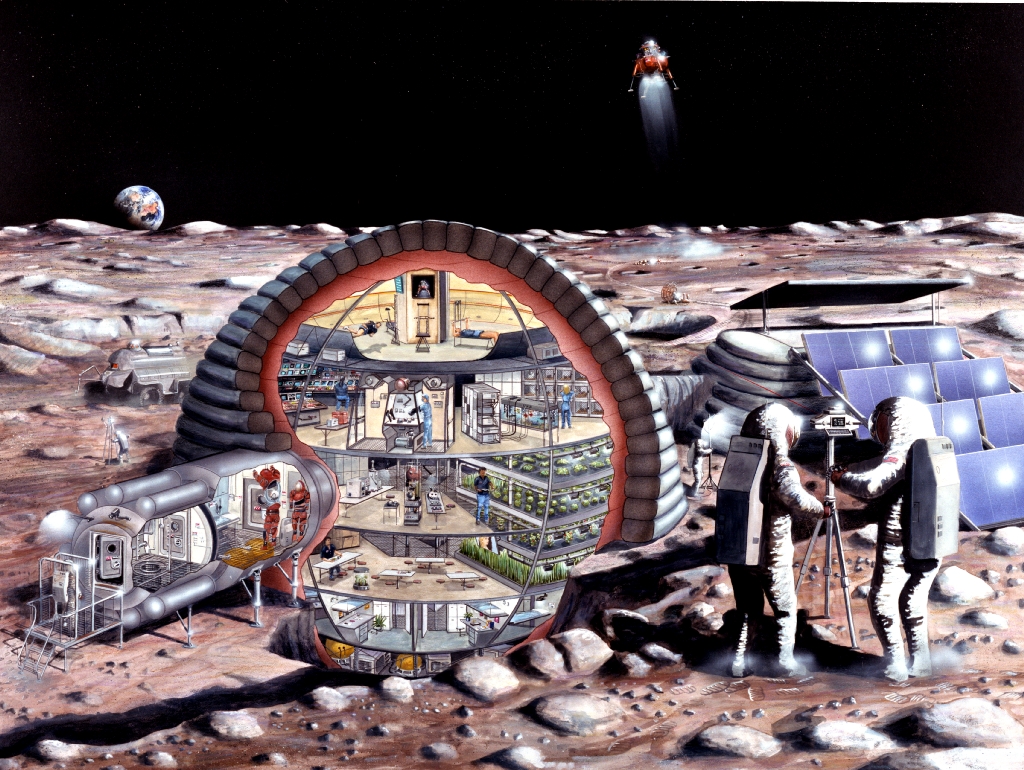
Luna Freeport did not start as a city.
It started as a failure.
A failed mining corridor.
A half-finished tunnel system abandoned by an early UEB contractor.
A logistics depot that never received funding for full development.
The tunnel remained sealed, dark, and forgotten—
until the sovereign enclaves needed a place
that belonged to no one.
Shackleton Accords gave them a governance model.
The Lunar Halving gave them a shared calendar.
But they needed something deeper:
a home that no single enclave or ideology could claim.
A neutral ground.
A commons that wasn’t owned.
That abandoned corridor became the seed.
They dug.
They wired.
They pressurized.
They argued.
They compromised.
They kept digging.
Luna Freeport became the first extraterritorial zone in human history—
not controlled by UEB,
not governed by any enclave,
not under any Earth treaty.
Just free.
II. The Law of the Corridor
Freeport needed rules.
But not Earth’s rules.
So the enclaves created a principle older than constitutions:
“What you bring in, you own.
What you build, you maintain.
What you share, you protect.”
Three simple pillars:
1. No Surveillance
UEB monitors were banned.
Internal sensors were minimal—
pressure, temperature, structural integrity, nothing else.
2. No Political Flags
No enclave symbols.
No Earth banners.
No factional markings.
Everything inside Freeport stayed neutral ground.
3. No Coercive Authority
The corridor had no police force.
Disputes were handled by rotating conflict circles—
any decision reversible by open consensus.
Freeport became messy.
But it was honest.
III. The First Archive Vault
The turning point came after the Exodus Protocol leaked across underground networks on Earth.
UEB officials issued “corrective history advisories.”
The IRVB restricted research deemed “misaligned.”
Several Earth universities quietly deleted pre-Protocol records.
The diaspora realized something terrifying:
Earth was beginning to rewrite the truth.
So Luna Freeport expanded into its first major construction project:
The Archive Vault.
Part data-haven.
Part library.
Part memory cathedral.
Ledger backups, Exodus journals, cryptographic seeds, habitat blueprints, independent scientific papers, early sovereign legal codes — all of it poured into the Vault.
Some on Earth shrugged.
Some on Luna saw it as obvious.
But future generations would see it differently:
It was the first act of civilizational self-defense.
IV. Birth of the Archivists
The Archivists didn’t intend to become a group.
At first they were simply:
- coders
- linguists
- historians
- syncretic theologians
- ledger technicians
- children who showed unusual pattern affinity
They catalogued, annotated, preserved.
But as Earth’s UEB shifted more aggressively into narrative control,
the Archivists grew into something larger:
a neutral order devoted to the survival of truth itself.
Their oath was simple:
“We remember what others forget.
We preserve what others erase.”
The Archivists would later become central figures in Arcs 5 through 7,
guardians of the Exodus record,
bridges between worlds,
and stewards of the Sovereign Canon.
But here, in Arc 1, they were just librarians with mining helmets.
V. Free Markets, Free Ideas
Luna Freeport wasn’t only an archive.
It was also the first:
- free exchange zone for lunar energy
- Lightning hub between enclaves
- “customs-free” corridor for goods
- meeting ground for sovereign engineers
- sanctuary for defectors from UEB zones
UEB tolerated it—barely.
Freeport existed in a legal gray zone:
- too small to threaten
- too useful to shut down
- too decentralized to capture
- too culturally important to ignore
Over time, Freeport became the economic heart of non-UEB Luna.
And the cultural heart of the sovereign diaspora.
VI. Why Freeport Mattered
Freeport proved something radical:
Humanity could build a society
that was neither Earth nor anti-Earth—
but beyond Earth.
A civilization:
- without surveillance
- without coercion
- without ideological conformity
- without bureaucratic drainage
- without central narrative control
A place where sovereignty was not a slogan,
but a practice.
A place that would one day anchor
the greatest library in human history—
the Sovereign Archive.
Centuries later, the Archivists described Freeport’s founding with disarming simplicity:
“We built a place to breathe.”
Looking for comments…
Searching Nostr relays. This may take a moment the first time this article is opened.
Looking for comments…
Searching Nostr relays. This may take a moment the first time this article is opened.