
Free Article 1 (Dec. 13, 2025): The Bitcoin Chronicles — 1.A.0.0.4.1 - Sabbath Cycle — The Stillness Before the Launch

Andrew G. Stanton - Dec. 13, 2025
In the decades before the Pilgrim launches, humanity believed momentum was synonymous with progress.
Factories ran without pause. Markets demanded constant motion. Governments published five-year plans that assumed uninterrupted growth, uninterrupted compliance, uninterrupted extraction. Time itself had become a conveyor belt—one that could not be stopped without punishment.
And yet, scattered across the Earthbound world, small pockets of resistance practiced something strange.
They stopped.
Not in protest.
Not in rebellion.
But in deliberate stillness.
These were not movements with banners or spokespeople. They were families, engineers, farmers, and mathematicians who observed a rhythm older than bureaucracy. One day out of seven, they refused to optimize. They refused to scale. They refused to respond.
They called it rest.
To the administrative systems of the late 21st century, this behavior was deeply suspicious. Any activity that could not be measured, monetized, or accelerated appeared inefficient at best—and subversive at worst. Compliance culture tolerated leisure only when it served recovery for further output.
But this was something else.
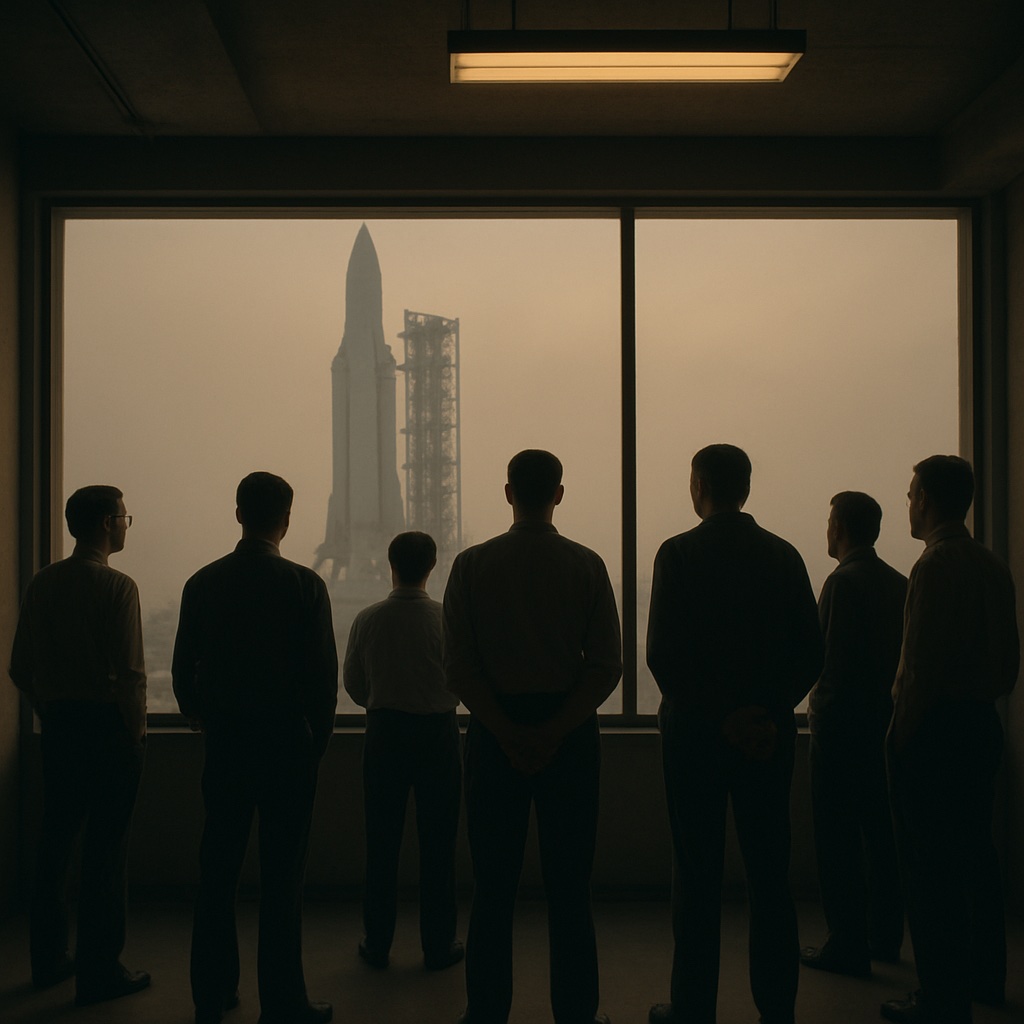
The stillness before the launch was not recovery.
It was orientation.
Those who practiced it understood something that would later become foundational to sovereign civilization: if every moment belongs to a system, then the system owns you. Sovereignty begins where time is reclaimed.
In quiet homes and unlogged gatherings, conversations unfolded that never appeared in official records. People spoke about limits—not imposed limits, but chosen ones. They discussed money that could not be printed faster by decree. Communication that did not pass through centralized filters. Travel that did not require authorization beyond physics itself.
These conversations rarely produced action plans. That was the point.
They produced clarity.
It was during these pauses that some began to realize that Earth’s problem was not scarcity of resources, but scarcity of restraint. Civilization had become incapable of stopping itself. Every solution demanded acceleration. Every fix required more throughput, more monitoring, more compliance.
The Pilgrim Program did not emerge from urgency.
It emerged from reflection.
The engineers who would later design off-world systems often traced their breakthroughs not to moments of frantic calculation, but to long walks, silent hours, and days deliberately set apart from output. They learned to distinguish motion from direction.
This pattern unsettled administrators.
Internal memos from the late compliance era reveal concern about “non-productive temporal clusters”—periods where individuals or groups reduced measurable activity without authorization. These clusters correlated, oddly, with higher rates of defection from centralized systems.
Rest was becoming contagious.
What the memos failed to grasp was that sovereignty requires margin. A society that consumes all of its time cannot imagine alternatives. Only when motion ceases can orientation occur.
When Pilgrim-1 finally launched, many assumed it was the result of desperation. A final escape from tightening controls.
The truth was quieter.
The launch followed years of deliberate slowing—of thinking in longer horizons, of stepping outside the rhythm imposed by Earthbound systems. Those who boarded the Pilgrim ships were not fleeing chaos.
They were leaving a civilization that had forgotten how to stop.
Later, among the sovereign settlements, this principle was preserved deliberately. Not as nostalgia, but as engineering. Systems were designed with pauses. Ledgers recognized cycles of rest. Work was bounded. Time was no longer a resource to be strip-mined.
The Sabbath, as it came to be understood off-world, was not religious ornamentation. It was a safeguard against civilizational collapse.
The stillness before the launch was not an absence of progress.
It was the condition that made progress possible.
And in the long view of the Sovereign Archive, those quiet, unrecorded pauses may have mattered more than any single breakthrough—because they taught humanity how to choose direction instead of momentum.
Looking for comments…
Searching Nostr relays. This may take a moment the first time this article is opened.
Looking for comments…
Searching Nostr relays. This may take a moment the first time this article is opened.