Running My First Half Marathon
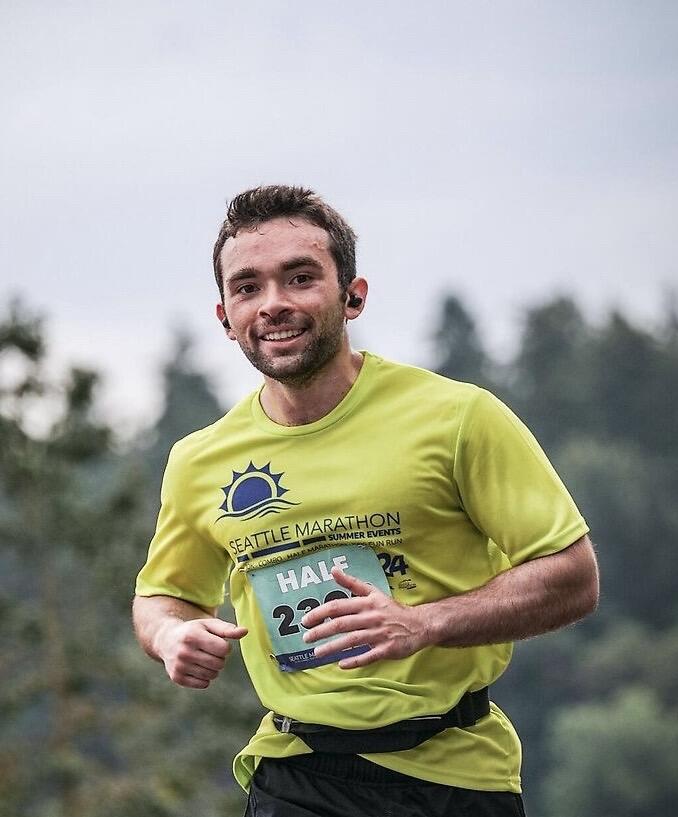
During my second year in Seattle, having completed my very first blue belt Brazilian Jiu Jitsu tournament, I decided to shift the focus to running. I had already been running around 1-2 times a week to compliment the Jiu Jitsu, but it had never been the primary thing; mostly a 45-to-60 minute period during which I (ignorant of the beauty of running outside) ran on a treadmill while watching video essays on movies or video games. I was already falling out of love with weight lifting, and the idea of incrementally improving both the pace and the duration I could run was an appealing alternative. And so, I started running more. 60-minute Zone 2’s became the first step of what would be the “+1 minute every run; +0.1 mph every week” ladder: every time I stepped on the treadmill, I either ran as long as I did the last time, or 1 minute more; every week (sometimes 2), I ran 1 mph faster than the week (or 2 weeks) before. I did not want my legs to get used to the surface magically moving backwards, so the Sunday run was at the Olympic Sculpture Park. It felt less like a schedule and more like law. 5.5 mph on the treadmill for 60 minutes became 6.5 for 75, which then became 7.5 for 90. As the weather in Seattle got better, I replaced most of my treadmill runs with the Olympic Sculpture Park run. The idea of running inside, under artificial light and with no fresh air became much more undesirable, especially compared to running with the view of Puget Sound on the left, and stepping over the same cracks and bumps so often that they start feeling like home. I had fallen in love completely, and decided to take it a bit further by signing up for a half-marathon and seeing what I could do.
The first 3-4 miles of the Seward Park Half Marathon are the most challenging. The park itself is an L-shaped half-island with high elevation for how small it is; it is an island-park-mountain with a primary trail going around the circumference and steep shortcuts through the island and nice summer houses all around. And the race starts with running up and down on those shortcuts and around the entire park twice before you know that you will not have any more elevation changes again. In other words, it ensures that you will get tired as soon as possible.
My goal is to finish in 1 hour and 50 minutes, which is a 5 minutes and 12 seconds per kilometer pace. For large races like these, the organizers have pacers among the crowd who will run the race in the time they have on the signs they carry. I do not remember exactly what led me to make this decision - the lack of a 1:50 pacer, or just feeling daring - but I found myself lining up behind the 1:30 pacer instead, closer to start line, with all of the other racers who I share an affection for running with. In a crowd like that, it is very difficult to not feel energized. Hundreds of minds all focused on the single course ahead of us, all having done countless runs on their own treadmills and Olympic Sculpture Parks, listening to their Måneskin and their League of Legends soundtracks… There is a sense of connection through both what we share - the present, the goal, the race - and what we don’t - everything that brought us to that point. The collective intention to run the race shines through everyone, and it is a wonderful thing to be a part of.
With the sound of my family cheering for me up the hill to my right, I start running. People who share a goal in a pace flock around their pacers, and I find my squad of 7-8 racers. I realize that these people, whose names I do not know, who I have never seen before, will be my team as we climb the steep shortcuts through the island-park-mountain and run around its circumference twice, only to return to flat ground and run the remaining 9-10 miles of the race.
At this point, there is no better way to convey what we are all going through than: keep running, do not stop, do not fall behind the pacer, do not fall behind others, keep running. Lake Washington’s beauty and the freshness of the air do not stay in the foreground of my mind. The fatigue of the steep initial miles becomes the baseline on which every mile will add on to. I see my family twice as we run around the park towards mile 5, and their cheers give me an amount of energy and motivation only they could give with such ease. I am having so much fun, feeling more tired with each step, and the lemon flavored energy drinks I grab from the hydration stations and splash on my face (twice), thinking that they are water, are not helping. But me and my 1:30 squad are chugging along.
Over time, more members of the squad fall behind the pacer, until only I and another guy in an orange tank top remain. Both of us are 10-15 steps behind the pacer, who looks like he will finish the race at exactly 1:30:00:000 without a single drop of sweat, and we are directly next to each other. With the same step length and the same speed, sharing what I assume are similar thoughts in our heads of perseverance, ignoring the constantly increasing pain, we are running towards mile 8. We are not in perfect synchrony. In fact, both of us are trying to avoid the awkward moment of being perfectly in sync with another stranger who is running by our side.
I am getting very, very tired, running at a pace I never ran before for this long during my Olympic Sculpture Park runs. My form is slowly crumbling, and I can tell that I am not going to be able to hold the 10-15 step distance from the pacer. When I look at my right, however, I can tell that my friend in the orange tank top is set to retain this distance we have had with the pacer, if not close it. Even though I most likely guaranteed that I will finish sooner than my initial 1:50 goal, at that moment, the last thing I want to see is an orange tank top gradually moving farther and farther away from me, until I can neither see it or the sign that says 1:30. And so, while holding on to a sustainable breathing pattern, left earbud clogged by all the sweat it collected over the past hour and some, I speed up.
It is a stupid decision to make, to speed up at a point when my breathing and pace will still probably give me a 1:45 finish. A wrong step and a face plant would be both an end to the race. But the logic is long gone, so I speed up. And so does the orange tank top guy. He does not let me take a lead, even if it is only a couple of centimeters at most. Gotten used to running next to each other, both of us know exactly where the other should be when are side by side. So he closes the gap, and only to re-open it himself. Without letting too much time pass just a few centimeters behind him, I close the gap again, and we start doing this dance in the middle of our race where both of us keep the other in check.
Note that this is looking nothing like a movie scene where both of us are finding absurd speeds out of nowhere, and exchanging positions every ten seconds. It is much more slow and hidden. A few centimeters, and retain that for a minute. Slowly close the gap, and keep that for another. It is a very slow exchange of motivation, but we are keeping each other in check. No one wants to fall behind the other, and we make use of that spontaneous friendly rivalry to carry us forward.
That is, until I cannot keep up. Around halfway through what I assume was mile 9, what I am afraid of becomes reality, and my orange tank top friend puts a permanent distance between us. I find a new, slower pace which leads to me eventually losing sight of both the 1:30 sign and the orange tank top. I mostly sustain that pace until the final mile, when the pain in my legs and the side of my body reach its peak. I continue running, knowing that if I do stop it is going to be even more difficult to get back up to speed. And finally, I push myself through the finish line where I started the race 1 hour 37 minutes and 42 seconds ago.
Walking away from the finish line, trying to keep some activity in the body to make sure that my heart gets used to easiness slowly, I see the orange tank top guy. We recognize each other others effort with a hug and a “Congratulations!” and then walk away, never to see each other again. Having bonded over the same struggle, and pushed each other towards the same goal, we formed this ephemeral relationship which I still remember to this day, and look back fondly at enough to write about in a random blog post and publish it in my first post on a decentralized internet protocol.
Speaking of, this is my very first blog post, and also my very first Nostr post. I’ve always wanted to write about stuff I am interested in like software engineering, Bitcoin, privacy, Jiu Jitsu, etc., and I want to use Nostr to publish and display what I write. Sharing things which I put a lot of energy into seemed to be a good way to support the protocol which I hope becomes a bigger part of the future internet.
To all 10 of you, thanks for reading this short story about a half-marathon.
CC0 1.0: All rights are released into the public domain.
Looking for comments…
Searching Nostr relays. This may take a moment the first time this article is opened.
Looking for comments…
Searching Nostr relays. This may take a moment the first time this article is opened.